
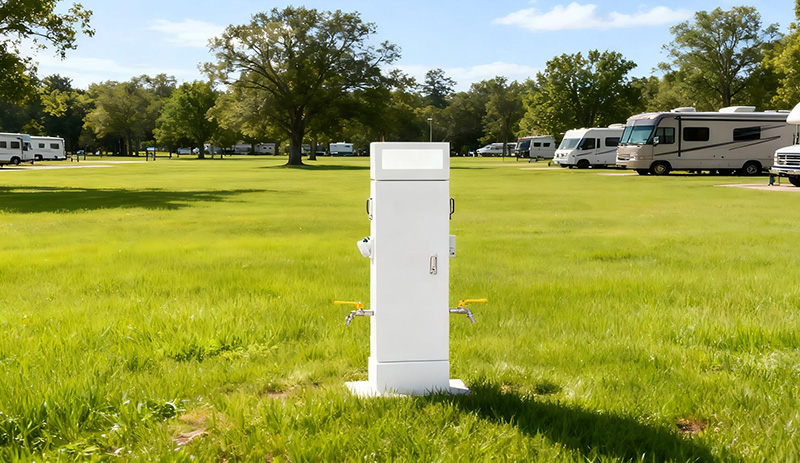
What the Series Includes as Standard
One column handles every power and water connection a single pitch needs, so an operator installs one unit, digs one trench and maintains one assembly instead of coordinating separate water and electrical points. Everything in the specification follows from that decision, which is why the series carries more outlets and faucets than a single-vehicle pitch appears to need at first glance.
One Column for Every Water and Power Connection
Power sockets and the water faucet sit inside a single column, so one excavation and connection point serves the whole pitch. On a new build this cuts civil works, and on a retrofit it removes the need to run supply routes to two separate pieces of equipment. Guest interaction also stays in one place, which means refilling a tank and connecting shore power happen at the same spot rather than at opposite ends of the pitch.
Four Sockets and Two Faucets as Standard
Four sockets support simultaneous use by the RV, a trailer and accessory equipment, which matters on sites where guests arrive with more than one vehicle. Two water outlets allow RV tank refilling and general pitch water use at the same time, with no queue and no shared hose. Both counts are identical across all three tiers, so the choice between models never reduces the number of outlets a guest can use.
Built-In Electrical Protection
The unit carries leakage, overload and short-circuit protection, with a leakage protection operating value of ≤30mA / 0.1S. These devices are installed inside the assembly rather than supplied as external add-ons that a site has to buy and wire during commissioning. The specification a buyer approves is therefore the specification that reaches the site.
LED Lighting and the 1000 mm Column
An integrated LED light makes nighttime connection practical without a separate post light, a detail guests notice when they arrive after dark. The 1000 mm column height provides a comfortable operating height and greater internal wiring space for the electrical configuration. Water and power circuits are also held in independent compartments, so moisture cannot reach the electrical components.
How the Three Tiers Differ
The series is not one product offered in three sizes, and the naming follows pitch application rather than a sequence of numbers. All three models share a 1000 mm column height and a 200 mm section width, and the difference runs along the length at 200 mm, 250 mm and 300 mm. Length sets the internal space capacity, and internal space determines which electrical configurations a site can specify.
GRWE1002020D-R for Standard Single-Vehicle Pitches
The 2020 tier is the most compact unit in the series, with a 1000×200×200 mm envelope. It suits standard single-vehicle pitches, occupies little installation space, and fits layouts where pitch spacing is tight and single-vehicle use dominates. Sites working to a fixed equipment budget without giving up the standard four-socket configuration generally land here.
GRWE1002520D-R for Twin-Vehicle and High-Density Layouts
The 2520 tier extends the length to 250 mm, which provides the internal space for a more complex socket and piping configuration. It suits pitches serving two vehicles or high-density layouts where one unit is expected to cover two connection points. Because one pedestal replaces two, the total number of columns and excavation points drops, and that reduction carries through to long-term maintenance work.
GRWE1003020D-R for Premium and Long-Stay Pitches
With a 300 mm length, the 3020 tier carries the greatest internal space in the series and suits premium pitches, long-stay pitches and projects with higher configuration requirements. Long-stay guests often run air conditioning, water heating and cooking equipment on the same pitch, and this is the tier specified when that load pattern is expected. The additional volume also allows a wider choice of protection devices and terminal arrangements.
Where the GRWE100 Series Sits in the Wider Range
Two shorter pedestals in the same material and protection class suit sites where a 1000 mm column exceeds what the pitch requires. The GRWE(B)801212 Series is sized for small RV parks and campgrounds, and the GRWE801515 Series covers courtyard accommodation and minor RV parks, both built in 304 stainless steel with IP54 overall and IP67 socket protection. Where water supply is the only requirement, round water supply pedestals suit gardens, swimming pool surrounds and park walkways, square water supply pedestals offer a choice of one or two taps, and the Garden Master hose reel columns integrate an automatic hose reel for landscaping use.
| Tier | Model | Dimensions (H x L x W) | Internal Space | Typical Pitch |
| 2020 Tier | GRWE1002020D-R | 1000 x 200 x 200 mm | Standard | Standard single-vehicle pitch |
| 2520 Tier | GRWE1002520D-R | 1000 x 250 x 200 mm | Ample | Twin-vehicle / high-density layout |
| 3020 Tier | GRWE1003020D-R | 1000 x 300 x 200 mm | Most ample | Premium / long-stay pitch |
Model Comparison
The tables below separate what is common across the three models from what changes, which is the fastest way to see whether the tier decision affects a particular project. Every figure in the shared specification rows applies to all three models without exception.
Shared Electrical and Water Specifications
All three tiers carry four sockets and two water faucets, with independent water and power control so each circuit can be managed separately for zone control and maintenance. The leakage protection operating value is ≤30mA / 0.1S across the series. Because outlet counts do not vary, the tier decision is about capacity headroom rather than about how many devices a guest can plug in.
Materials, Protection Ratings and Durability
The series uses thickened 304 stainless steel in a one-piece formed body, with UV resistance, rust prevention and a salt spray test result of at least 480 hours. The overall protection rating is IP54 and the sockets are rated IP66 and above, which covers rain, humidity and direct UV exposure in open installation. Impact resistance is IK10, covering deliberate damage, vehicle scuffs and hard object impacts without deformation during long-term outdoor use.
How Internal Space Changes What You Can Specify
Internal space sets how much room the electrical configuration has inside the column, and that room becomes specification options rather than performance differences on shared items. A project that needs additional protection devices, a more involved terminal arrangement or capacity for future expansion benefits from the larger tiers. A project with a settled standard configuration and tight pitch spacing gains nothing from capacity it will never use.
| Specification | GRWE1002020D-R | GRWE1002520D-R | GRWE1003020D-R |
| Dimensions (H x L x W) | 1000 x 200 x 200 mm | 1000 x 250 x 200 mm | 1000 x 300 x 200 mm |
| Sockets | 4 | 4 | 4 |
| Water faucets | 2 | 2 | 2 |
| Material | Thickened 304 stainless steel | Thickened 304 stainless steel | Thickened 304 stainless steel |
| Coastal upgrade option | 316 stainless steel available | 316 stainless steel available | 316 stainless steel available |
| Overall protection rating | IP54 | IP54 | IP54 |
| Socket protection rating | IP66 and above | IP66 and above | IP66 and above |
| Impact resistance | IK10 | IK10 | IK10 |
| Corrosion resistance | Salt spray test ≥480 hours | Salt spray test ≥480 hours | Salt spray test ≥480 hours |
| Electrical protection | Leakage / overload / short circuit | Leakage / overload / short circuit | Leakage / overload / short circuit |
| Leakage protection value | ≤30mA / 0.1S | ≤30mA / 0.1S | ≤30mA / 0.1S |
| Control | Independent water and power control | Independent water and power control | Independent water and power control |
| LED lighting | Yes | Yes | Yes |
| Internal space | Standard | Ample | Most ample |
| Typical positioning | Compact single-vehicle | Twin-vehicle, expandable | Premium high-capacity |
Choosing the Right Tier for Your Site
Selection follows how a pitch will be used rather than a specification table. A campground running at high occupancy with single vehicles has different capacity requirements from a seasonal site hosting long-stay guests with larger rigs, even when both need the same electrical protection. Total connected load across the site is what fixes the amperage available per pitch, and the 50/30/20 amp RV pedestal configuration guide works through how that split is normally drawn.
Standard Pitches and Cost-Sensitive New Builds
For standard single-vehicle pitches, the GRWE1002020D-R meets single-pitch water and power needs at a lower equipment cost, and its compact structure suits tight pitch spacing. The standard four-socket configuration still covers an RV plus accessory equipment. New campgrounds working to a fixed budget often specify this tier across the site and reserve larger models for pitches that will be marketed differently.
Twin-Vehicle and High-Density Campgrounds
Where a pitch serves two vehicles or the layout is high-density, the GRWE1002520D-R lets one unit cover two connection points. This reduces the total number of columns and excavation points across the site and shortens the maintenance route, since fewer assemblies means fewer inspection stops. Operators who expect to add capacity later also favor this tier, because the extra internal space leaves room for configuration changes without replacing the pedestal.
Premium, Seasonal and Long-Stay Sites
The GRWE1003020D-R suits premium pitches, long-stay pitches and seasonal campgrounds where water and power use is more frequent and more concentrated. Its internal space is the greatest in the series, which supports heavier configurations and matches the visual standard of a premium campground. The tier decision here is driven by expected load and the equipment a guest is likely to run, not by the footprint.
Coastal Sites and High Salt Spray Locations
Any tier can be specified with 316 stainless steel where a site is exposed to coastal air or heavy salt spray, since the 316 option is available across the series and does not force a change of model. The standard 304 body already carries a salt spray test result of at least 480 hours. Marina and dock projects frequently combine the 316 material with the marine variant of the pedestal, which uses the same internal standards in a shore power arrangement.
| Application Scenario | Recommended Model | Reason for Selection |
| Standard single-vehicle pitch | GRWE1002020D-R | Compact structure and small footprint, meeting single-pitch water and power needs at a more economical equipment cost |
| Twin-vehicle pitch / high-density layout | GRWE1002520D-R | One unit serves two vehicles, reducing the total number of columns and excavation points and simplifying maintenance |
| Premium pitch / long-stay pitch | GRWE1003020D-R | The most ample internal space, with a visual presence matching a premium campground |
| Seasonal campground / long-stay scenario | GRWE1003020D-R | High-capacity configuration suits the more frequent and concentrated water and power use of long-stay guests |
| Budget-sensitive new campground | GRWE1002020D-R | Controls equipment and civil works costs while meeting basic connection requirements |
| Coastal / high salt spray areas | Any model + 316 material | 316 stainless steel is available across the series for improved salt spray corrosion resistance |
| Scenic areas, farm stays, outdoor parking | GRWE1002020D-R or 2520 | Suits power and water access requirements in scenic areas, farm stays, parking facilities and other outdoor settings |
Materials and Installation
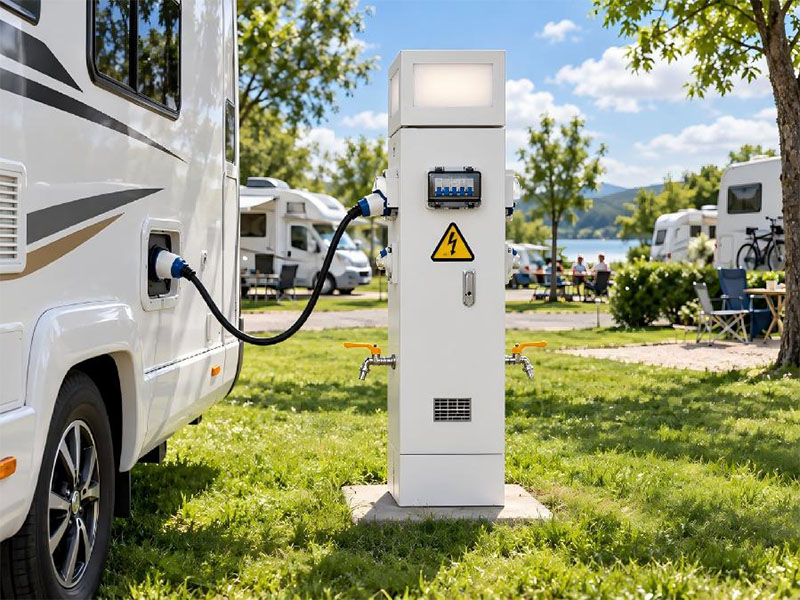
304 Stainless Steel and the 316 Coastal Option
The entire series uses thickened 304 stainless steel in a one-piece formed body, resistant to corrosion and sunlight, with a salt spray test result of over 480 hours. For coastal or high salt spray projects, 316 stainless steel is available for better resistance to salt spray corrosion. The material decision is usually made once per project rather than per pitch, because mixing materials across a site complicates both procurement and the maintenance spares list.
Physical Separation of the Water and Electrical Circuits
Water and electricity are separated by a layered physical design, with the water circuit and the electrical circuit placed in independent compartments. This prevents moisture from contacting electrical components and is a baseline safety requirement for any outdoor water and power unit. It is also why the assembly can be serviced without isolating both utilities at once, since independent water and power control allows each circuit to be managed separately.
Surface Mounting and Concrete Embedding
Two installation methods are supported. Surface mounting uses expansion bolt fixing and has a short lead time, which suits retrofit work and sites where the ground is already prepared. Concrete embedding requires a poured base and takes approximately 3 to 5 days. Installation labor runs to approximately 1 to 2 person-days per pedestal, and units ship with internal modules pre-installed, so on site only the power connection, the water connection and the fixing are required. Where a socket has to sit flush with the ground rather than on a column, the DP Series in-ground pedestal mounts flush at the surface with IP66 protection.
Component Standards Behind the Enclosure
The selection of internal electrical components and the standards they are built to determine long-term reliability and safety, and those are the parts a buyer cannot inspect after installation. All electrical components in the GRWE100 Series are configured according to International Electrotechnical Commission standards, and every core part is specified to the standards of established international brands rather than left open to substitution. The unit is engineered with industrial-grade safety margins for demanding outdoor electrical environments.
Sockets and Panel Sockets
Industrial sockets are specified to EN IEC 60309-1 and EN IEC 60309-4, and panel sockets to EN IEC 60884-1. The first pair covers the CEE-form connectors used for higher-amperage shore power, which are listed under industrial sockets, while the second covers the domestic-style outlets on the same unit. These standards govern the current ratings, contact arrangements and ingress protection of the connectors a guest actually plugs into. Because the socket interface takes the most physical wear of any part of the pedestal, specifying to these standards feeds directly into how long the unit stays in service.
Circuit Breakers and Earth Leakage Protection
Miniature and residual current devices follow EN IEC 60898-1, EN IEC 61008-1 and EN IEC 61009-1, while molded case circuit breakers follow EN IEC 60947-2. These standards cover the tripping characteristics that determine how the unit responds to overload and earth leakage faults. Marinas and RV parks present fault current conditions that differ from ordinary commercial installations, and the protection margins built into these devices are what allow the pedestal to operate safely under them. Marina sites also have to meet GFPE requirements for shore power at the installation level, which sit above the protection contained inside a single unit.
Terminal Blocks and Cable
Terminal blocks are specified to EN IEC 60947-7-1 and cable to EN IEC 60227-3. These parts are rarely seen by an operator, but they decide whether internal connections stay reliable through years of thermal cycling and vibration. Cable insulation performance in particular affects service life in coastal and humid environments, where moisture ingress is the most common cause of premature failure.
| Component | Execution Standard |
| Industrial sockets | EN IEC 60309-1, EN IEC 60309-4 |
| Panel sockets | EN IEC 60884-1 |
| MCB / RCCB / RCBO | EN IEC 60898-1, EN IEC 61008-1, EN IEC 61009-1 |
| Molded case circuit breaker | EN IEC 60947-2 |
| Terminal blocks | EN IEC 60947-7-1 |
| Cable | EN IEC 60227-3 |
Maintenance Schedule
Maintenance divides into a short weekly routine and a slightly longer monthly one, and both are inspection-led rather than repair-led. The value comes from catching cover damage, seal wear or a sluggish protection device before it reaches a guest. The schedule can be adjusted according to site location, climate and frequency of use.
Weekly Checks
Check the socket protective covers, the column housing, the lighting and indicator lights, and the door lock. Covers and seals take the most guest handling, and a cracked cover is the earliest warning of moisture problems. Confirming that lighting and indicators still work also catches supply faults that a guest would otherwise report after dark.
Monthly Checks
Check the internal cables, terminal blocks and the leakage protection test button, and clean internal dust. The protection test button is the only item on the list that confirms a safety function rather than a cosmetic one, so it should not be skipped on sites with high occupancy. Dust removal keeps the housing’s own heat path working, since a blocked ventilation opening reduces cooling efficiency over time.
Frequently Asked Questions
Next Steps for Your Project
Send a pitch plan with the intended pitch types and the site’s coastal exposure, since tier selection follows how each pitch will be used rather than a specification sheet. JIYA Intelligent manufactures outdoor power distribution pedestals for RV parks, campgrounds and marinas, with project-specific customization available through OEM and ODM services. Send your requirements through the contact page and our team will recommend the tier that matches your layout.

About the Author
Boda Pan
Engineer, JIYA Intelligent
Boda Pan is an engineer at JIYA Intelligent with five years of experience in outdoor power distribution. He specializes in RV power pedestals, water and power pedestals and marina water and electric pedestals, with a focus on IEC standards compliance.