
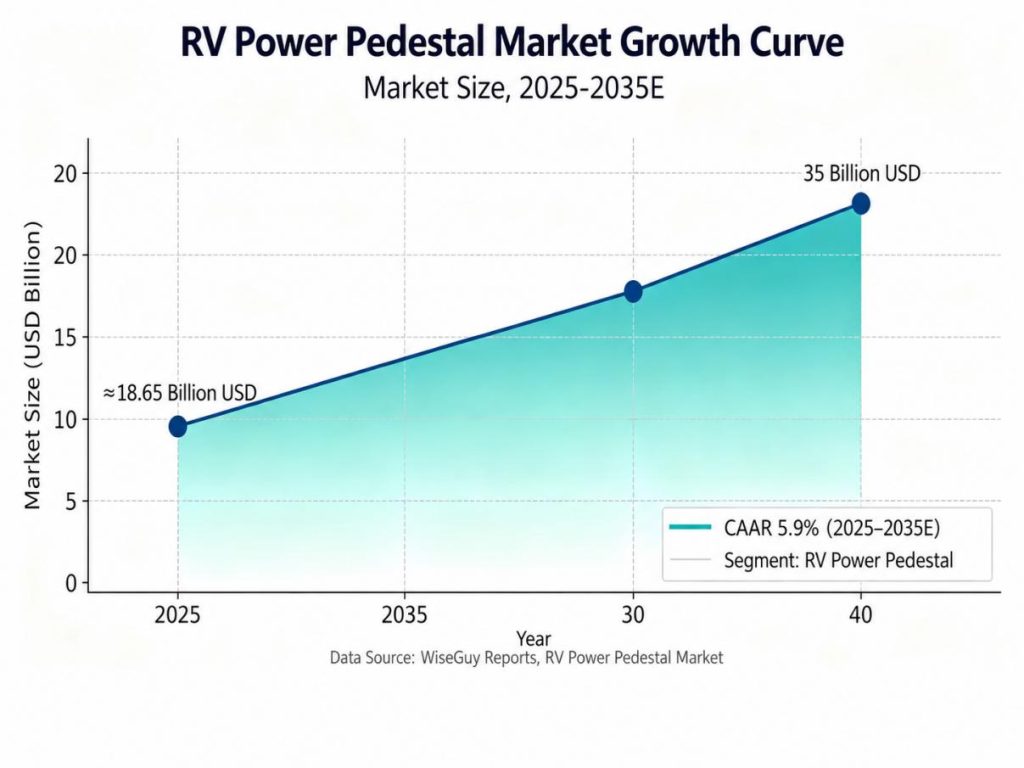
The RV Power Pedestal Market research report published by WiseGuy Reports puts the global market at approximately USD 1.865 billion in 2024 and USD 1.975 billion in 2025. The same report projects USD 3.5 billion by 2035, a compound annual growth rate of 5.9 percent over the forecast period. The report covers four application segments, namely campgrounds, marinas, mobile home parks and recreational vehicle shows, and its forecast period runs from 2026 to 2035. The two starting years are reported separately because the growth rate applies to the forecast period, not to the gap between the 2024 figure and the 2035 projection.
This growth reflects both the continued expansion of RV tourism and the pressing need for campgrounds to upgrade their electrical infrastructure. For operators of RV parks, campgrounds and holiday resorts, understanding the drivers behind this market trend matters more than focusing on the figures alone. Electrical infrastructure is usually the hardest part of a site to change once it is built, because upgrading means excavation, new cable routes and new foundations. Planning ahead costs far less than fixing later.

How Large Is the RV Power Pedestal Market and How Fast Is It Growing
| Metric | Value |
| Market size in 2024 | Approximately USD 1.865 billion |
| Market size in 2025 | Approximately USD 1.975 billion |
| Projected size in 2035 | USD 3.5 billion |
| Compound annual growth rate | 5.9 percent |
| Forecast period | 2026 to 2035 |
| Segment covered | RV power pedestals |
The figures above come from a single research publication, and it is worth being explicit about that. Other research firms publishing on the same market give materially different estimates, with 2025 values ranging from around USD 190 million to around USD 660 million depending on how narrowly the segment is defined. The figures should therefore be read as one analyst view of the market rather than a settled number, and the direction of travel matters more than the absolute value.
What the Market Size Growth Means for Operators
A compound annual growth rate of 5.9 percent means a substantial amount of new market value is added each year over the coming decade. Behind that figure are thousands of pitches each year that require new or replacement power pedestals. For campground operators, the question is not whether to upgrade, but when to upgrade and to what extent.
Growth of this kind is not distributed evenly across the decade. Infrastructure renewal arrives in concentrated cycles. When a group of campground installations reaches the end of its service life at the same time, or when local regulations are updated together, renovation demand rises quickly over a short period. Suppliers see this as capacity pressure and longer lead times, while operators planning at the wrong moment face both. Planning ahead is therefore better positioned on cost control and on guest experience.
Where the Growth Comes From in New Builds and Retrofits
Market growth does not depend only on new campground construction. Retrofit and replacement work is a major and often underestimated driver of demand, and for equipment suppliers it is the more stable part of the picture. New build demand rises and falls with property development cycles, while replacement demand runs continuously as installations reach the end of their service life.
As RV tourism and the camping economy continue to expand, a large number of new campground projects are being planned or built worldwide. These projects tend to specify smart power pedestals with metering, QR payment and remote management from the outset. Equipment sold into new build sites is therefore configured at a higher specification than the sites that came before them. For a supplier this raises the technical content of each order, because metering and remote management bring documentation, commissioning and support requirements that a plain connection point does not.
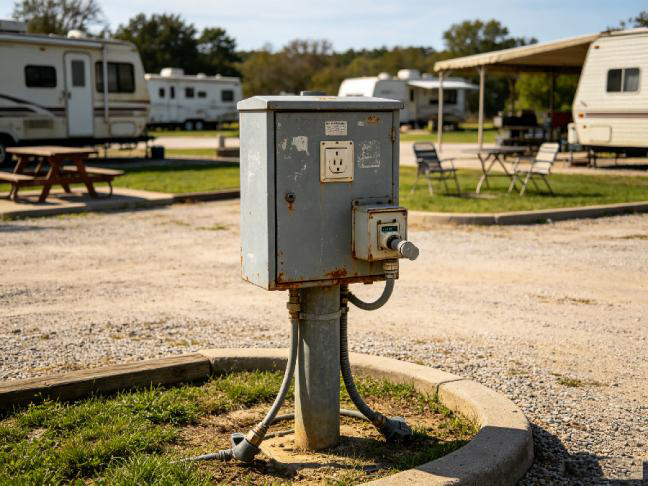
Many existing campgrounds still use fixed electrical installations put in ten or more years ago, and those installations often lack leakage protection, metering and sufficient power capacity. As equipment ages, regulations tighten and guest expectations rise, replacement demand accelerates. Retrofit projects do not depend on land development or new approvals, the decision cycle is short, and demand is distributed and continuous. That makes retrofit work a more predictable base than the new build market.
How Regional Demand Differs
By region, North America and Europe remain the main markets for RV power pedestals. Both regions have mature RV cultures, large numbers of campgrounds, and a significant share of infrastructure that has entered its renewal cycle. Strict electrical safety regulations and high guest expectations for convenience are also driving the adoption of metering and smart pedestals.
Asia Pacific is emerging as the fastest growing region. As RV tourism and the camping economy develop rapidly in China, Australia, New Zealand and elsewhere, demand for modern power pedestals in new campground projects is rising. These markets often skip earlier equipment generations and move directly to QR payment and remote management solutions, which means the specification conversations start at a more advanced point than they did in mature markets.
The practical consequence for operators is that equipment availability and lead times vary by region. A specification that is routine in one market may need a different socket interface, a different material grade or a longer delivery in another. That makes lead time a planning input, not a purchasing detail. Operators specifying for a site in an emerging market should confirm the socket standard and the lead time before the construction program is fixed.
Key Takeaways on Market Growth
- Market size in 2025 is approximately USD 1.975 billion, projected to reach USD 3.5 billion by 2035, with a CAGR of 5.9 percent
- The 2024 market size was approximately USD 1.865 billion, so the growth base and the forecast period should not be confused
- Growth comes from both new campground construction and retrofits, and retrofit demand is continuous
- North America and Europe are mature markets, while Asia Pacific is the emerging growth region
- Pedestals with metering and QR payment are expected to grow faster than the market average
- For operators, the coming decade is a window for infrastructure upgrades
- Published estimates for this market vary widely between research firms, so figures are best treated as directional
What Factors Are Driving Market Growth
Why Aging Campground Infrastructure Drives Replacement Demand
Many older campgrounds still use aging fixed electrical installations that lack the protection, metering and safety functions of modern pedestals. As equipment ages, replacing it with pedestals that include leakage protection, overload protection and metering becomes a basic requirement rather than an upgrade. This driver is largely independent of tourism growth, because the replacement decision arrives whether or not the site is expanding, and it applies to sites that are otherwise functioning well.
How Rising Guest Power Demand Changes Pedestal Specifications
Modern RVs are larger and carry more equipment. Air conditioning, refrigerators, microwaves, laptops, phones and electric bicycles all need charging, and guest expectations for a stable higher power supply continue to rise. The consequence for campgrounds is that the supply capacity planned a decade ago is frequently insufficient for the vehicles now arriving at the pitch.
This pressure shows up in two ways. The first is capacity, in that pitches are increasingly specified at 7 kW and above rather than at older rating levels. The second is protection. A higher connected load on the same cable run makes correct coordination between the breaker, the cable and the socket a more demanding exercise than it was when the loads were smaller.
How Metered and Paid Access Models Change Pedestal Choice
More campgrounds are moving from flat-rate connections to metered or paid access models. This approach is fairer between guests, helps operators recover electricity costs, and reduces waste at sites where power had previously been included in the pitch fee. Smart water and power pedestals are a central part of that transition, because the metering and payment functions have to be integrated into the pedestal rather than added afterwards.
The change also alters what operators buy. A pedestal that supports QR payment and provides an accessible back end is not only a power supply device but an operational tool. The equipment decision shifts from specifying a connection point to specifying a service point.
How EV Charging Is Being Added to Campground Power Pedestals
As electric vehicles become more common, campgrounds are starting to face new demand for vehicle charging. This demand currently represents a small share of the overall market, but it has begun to appear in campground specification discussions and will become a decisive planning factor over the coming decade. The question for most sites is not whether to add charging but how to prepare the electrical design so that it can be added without rebuilding the distribution.
These factors affect both new build and retrofit projects, so demand is not limited to new sites. A campground that upgrades a distribution board today can add vehicle charging capacity later at a fraction of the cost of a full replacement, provided the original design left room for it. The opposite also holds. A distribution board sized only for today turns later charging provision into a replacement project instead of an extension.
How the Marina and Mobile Home Segments Fit the Market
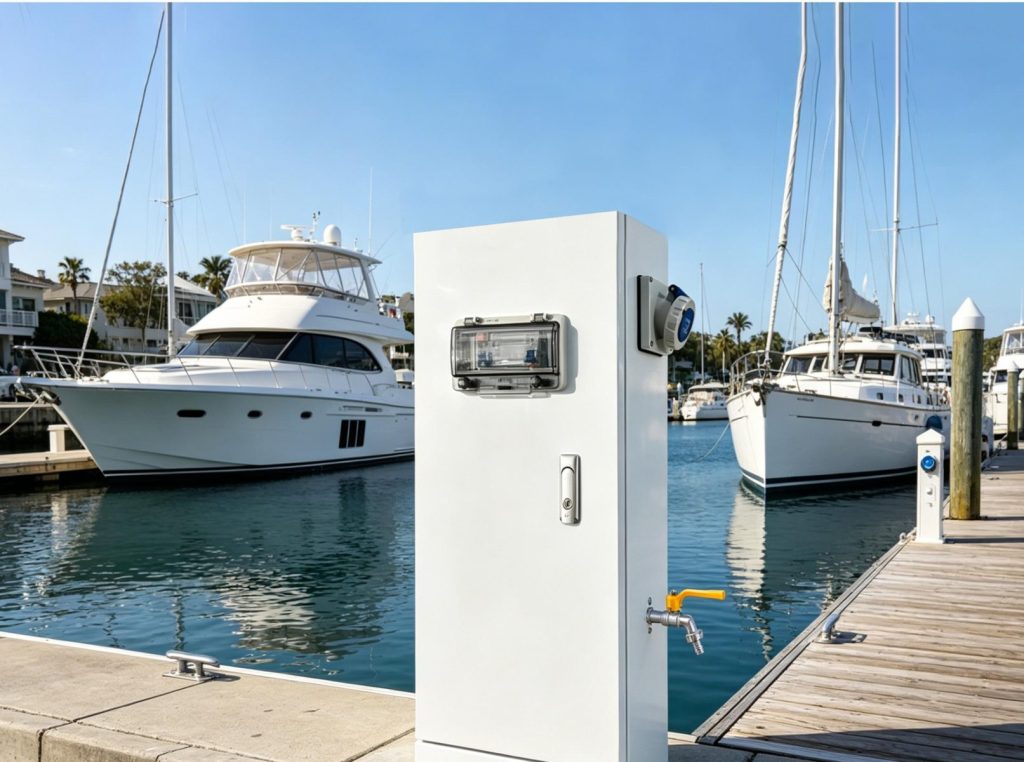
The market research report covers four application segments, and marinas sit alongside campgrounds, mobile home parks and recreational vehicle shows. That segmentation reflects how the equipment is actually used, because the same water and power pedestals appear on pontoons and quayside berths as well as on campground pitches. The segmentation also explains why a market total covering all four segments is larger than a figure limited to campgrounds alone.
Why Marinas Specify the Same Equipment
A marina berth has the same requirements as a campground pitch. A vessel needs a power connection and a water supply from a position it can reach easily. The equipment that serves a pontoon berth follows the same electrical protection chain, and the enclosure and impact ratings carry the same meaning. Manufacturers that build for both markets usually develop a single product platform with different materials and socket interfaces rather than two separate ranges.
For JIYA Intelligent this overlap is visible in the product range, where the same pedestal families serve campgrounds, marinas and waterfront sites. Product information across the marina power pedestal range and the RV park and campground range shows the shared platform and the selections that differ between the two. Buying from one platform means spares, maintenance procedures and documentation remain consistent across a mixed portfolio of sites.
What Differs Between Campground and Marina Installations
The differences between the two applications are concentrated in three areas, and each one changes the specification, not the fundamental design. All three are settled at the ordering stage, so they belong in the specification conversation.
- Material grade, because a pontoon or quayside installation sits directly over salt water and generally calls for 316 stainless steel rather than 304
- Mounting, because pontoon and quay installations have to accommodate movement, cable routing along the walkway and the practical limits of working over water
- Socket interface, because shore power standards and vessel requirements vary between regions and marinas serve a more international mix of users than most campgrounds
None of these change the protection logic or the ratings discussed elsewhere in this article. They change what is specified, which is why a supplier serving both markets can share engineering work while still meeting the requirements of each. From an operator perspective the practical benefit is a shorter specification process, because the underlying platform does not have to be evaluated twice.
What Market Growth Means for Campground Operators
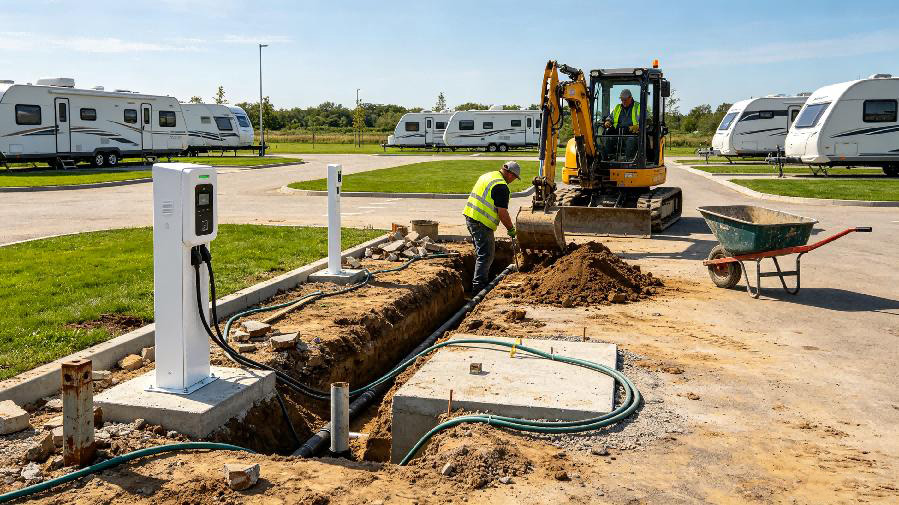
Behind the market growth figures, the real challenge for an operator is timing. Once electrical infrastructure is built, later modification is expensive, and two planning decisions carry the most weight. Both are made before the first trench is opened, and neither can be recovered cheaply afterwards.
How to Plan Capacity for the Next Decade
Configuring capacity for current demand alone often means rebuilding sooner than expected. Power demand growth over the next 5 to 10 years should be considered at the planning stage, with sufficient capacity margin allowed for it. The cost of that margin at the design stage is small, while the cost of adding it later includes excavation, cable replacement and the closure of pitches during the work.
How to Keep Configuration Flexible
Sites that plan to adjust their service model later, for example by moving from included power to metered charging, benefit from choosing equipment that supports that configuration from the start. Selecting water and power pedestals that support QR payment, remote metering and back-end management avoids full replacement later. Because configuration decisions have to be set before the equipment leaves the factory, they belong in the specification conversation rather than in a later upgrade project.
Frequently Asked Questions
No. Retrofit and infrastructure renewal form a major part of demand. Many existing campgrounds are upgrading aging equipment to meet guest expectations and improve operational efficiency. Retrofit work does not depend on new land development or approvals, so it produces a steadier flow of demand than the new build market. That is useful context for operators, because replacement equipment and lead times stay available during periods when new construction slows.
Equipment aging, higher guest power demand, and a shift towards metered or paid access models are the three main drivers. A fourth is appearing in specifications, because sites are preparing their electrical design for vehicle charging even where they are not installing it yet.
It means competition will intensify and guest expectations for power reliability and convenience will rise. Campgrounds that upgrade infrastructure early will be better positioned to attract and retain customers. Sites that defer the work tend to face higher costs when the equipment finally fails during a peak season. The case for upgrading early rests on avoiding that failure, not on the equipment price.
Look for pedestals with adequate power capacity, for example 7 kW and above, together with leakage protection, metering, QR payment, remote management capability and protection ratings suited to outdoor environments. The material grade matters as well, because coastal and waterfront sites generally call for 316 stainless steel. The socket interface should also be checked against the vehicles and appliances arriving at the site, particularly where international guests are expected.
Research firms define the segment differently. Some count only RV power pedestals, while others include the wider power pedestal market, and some include water and power pedestals that carry a significantly higher unit price. The definitions change the total, so figures from different publications are not directly comparable.
The electrical protection chain and enclosure ratings apply unchanged, and manufacturers commonly use one platform across both markets. What differs is the material grade, the mounting arrangement and the socket interface, all of which are specified per project. A manufacturer serving both markets can therefore supply a campground and a marina from the same platform without compromising either installation.
References
The market data in this article comes from the following publication, and the segment definitions noted above are taken from its scope statement. The 2024 and 2025 values are reported separately because the report distinguishes them. Any figure quoted from this article should carry the same distinction.
- WiseGuy Reports, Global RV Power Pedestal Market Research Report, forecast to 2035, published April 2026. Figures cited are a market size of USD 1,864.7 million in 2024, USD 1,974.7 million in 2025 and USD 3,500 million in 2035, with a CAGR of 5.9 percent over the forecast period from 2026 to 2035. Application segments covered are campgrounds, marinas, mobile home parks and recreational vehicle shows.
- Comparative market estimates referenced in this article are drawn from publicly published summaries by Market Research Intellect, pmarketresearch, Research Nester, Fortune Business Insights and Spherical Insights, which define the segment differently and therefore report different totals.
- JIYA Intelligent, guide to power pedestals, covering pedestal construction and specification.
- JIYA Intelligent, NEC Article 555 compliance guide for marinas and docks.
A note on the market figure. The growth rate and the endpoint figure are internally consistent only when the starting point is the 2025 value of USD 1.9747 billion. Multiplying 1.9747 by 1.059 over ten years gives USD 3.5 billion. Using the 2024 value as the starting point produces a lower endpoint, which is why the two years are reported separately above.
Working Out What Growth Means for Your Site
The RV power pedestal market is growing steadily, driven by aging campground infrastructure, rising guest power demand, changing service models and the early stages of vehicle charging integration. For campground operators this presents both a challenge and an opportunity. The equipment decisions taken now determine what the site can support for the next decade without excavation, and they are cheapest to make while the specification is still open.
Planning power capacity in advance and choosing water and power pedestals with configuration flexibility can reduce long-term operating costs and build an advantage in an increasingly competitive market. Where a site is served by both camping and marine berths, or expects to add metered charging later, the specification stage is when those options remain cheap to keep open.
JIYA Intelligent has been manufacturing outdoor power distribution pedestals and water and power pedestals for over 20 years, with products available for project-specific customization. Product information is published across the JIYA Intelligent website. Enquiries covering capacity planning, metering configuration and coastal material selection can be sent to the sales team at any time. Site plans and projected pitch numbers are welcome at the planning stage, because capacity questions are easiest to settle before the distribution design is fixed. Feel free to get in touch through our contact page.

About the Author
Boda Pan
Engineer, JIYA Intelligent
Boda Pan is an engineer at JIYA Intelligent with five years of experience in outdoor power distribution. He specializes in RV power pedestals, water and power pedestals and marina water and electric pedestals, with a focus on IEC standards compliance.