
For RV travelers, a good campsite is about more than a level parking space and a nice view. Reliable hookups make it possible to use air conditioning, appliances, lighting, water systems, and other everyday comforts without constantly relying on batteries or a generator. For campground owners and designers, however, an RV hookup is part of a much larger utility system. Electrical distribution, water supply, sewer connections, site layout, and safety protection all need to work together.

Key Takeaways
- RV park hookups typically include electricity, fresh water, and sewer, although individual campsites may offer only some of these services.
- A well‑planned campground electrical system should match the expected RV load, provide suitable 30‑amp and 50‑amp connections, and include appropriate protection.
- RV electrical planning starts with understanding power demand, not simply choosing the largest available connection.
What Are RV Park Hookups?
RV park hookups are the utility connections provided at an individual campsite. Depending on the campground, a site may offer electricity only, electricity and water, or a full hookup that includes electricity, fresh water, and sewer. A full‑hookup site generally provides all three utilities directly at the campsite. This allows an RV to remain connected for longer stays without needing to visit a separate dump station or rely entirely on its onboard water and battery systems. The three main services are:
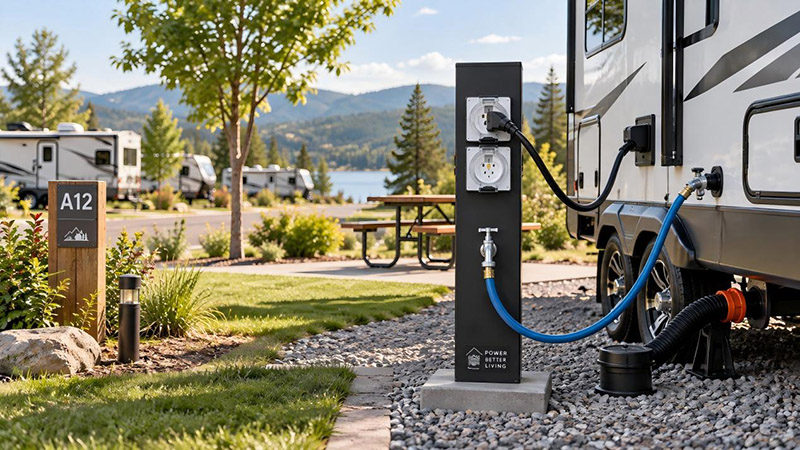
| Hookup | Purpose | Typical RV Use |
| Electricity | Supplies shore power to the RV | Air conditioning, appliances, outlets, battery charging |
| Fresh Water | Provides pressurized potable water | Sinks, showers, toilets, drinking water |
| Sewer | Connects wastewater outlets to the campground system | Black‑water and gray‑water drainage |
Understanding Campground Electrical Systems
Electricity is usually the most demanding utility in an RV park because several high‑power appliances may operate at the same time. Air conditioners, electric water heaters, refrigerators, microwaves, coffee makers, and other appliances can quickly increase the load. The first step in planning a campground electrical system is therefore to understand expected demand. A campground electrical system can be viewed as a chain that begins with the campground distribution system and ends with individual appliances inside the RV. Power travels through the park’s electrical infrastructure to the RV power pedestal, through the RV shore power cord, and into the RV’s electrical distribution system. This means that the campsite pedestal is only one part of the overall system. The upstream distribution equipment must also be sized to support the number of occupied sites and their expected loads.
30‑Amp vs. 50‑Amp RV Hookups
One of the most common questions about RV park electricity is the difference between 30‑amp and 50‑amp service.
| Feature | 30‑Amp RV Connection | 50‑Amp RV Connection |
| Typical RV Type | Commonly used for smaller RVs and travel trailers. | Designed for larger RVs with higher electrical demands, including many motorhomes and fifth wheels. |
| Electrical Supply | Typically provides a single 120‑volt supply. | Provides significantly more available electrical power for high‑demand RV systems. |
| Power Capacity | Suitable for basic to moderate electrical needs. | Better suited for multiple high‑power appliances and larger electrical loads. |
| Common Use | Often found at campsites designed for smaller RVs and trailers. | Commonly available at sites intended for larger motorhomes and fifth wheels. |
Many campground power pedestals include both 30‑amp and 50‑amp receptacles, sometimes alongside a standard 20‑amp household‑style outlet. However, not every campground provides the same combination, so RV travelers should confirm the available service before booking. For park designers, offering multiple connection options can make a campground suitable for a wider range of RVs. At the same time, the electrical distribution system must be designed around the combined demand rather than assuming every campsite will continuously operate at its maximum rating.

Planning Electrical Load for an RV Park
Good electrical planning starts with actual usage. A campground electrical planning approach commonly begins by estimating expected power demand. The basic calculation is:
Power in watts × hours of use = daily energy consumption in watt‑hours
For example, an appliance using 500 watts for two hours consumes approximately 1,000 watt‑hours during that period. The same thinking can be applied at the campground level. Designers need to consider the number of RV sites, expected occupancy, site classifications, seasonal demand, and the types of RVs the park is designed to accommodate. Planning should also leave room for future demand. An RV park that is adequate for today’s average RV may face greater electrical requirements as larger RVs, additional appliances, electric vehicles, and other electrical equipment become more common.
Designing the RV Electrical Distribution System
Once the expected load is understood, the next step is designing how power will reach each campsite. A typical campground electrical system includes several stages:
- Utility or primary power source
- Main electrical distribution equipment
- Distribution feeders
- Branch circuits or site‑level distribution
- RV electrical pedestals
- RV shore power connections
The exact configuration depends on the size and location of the campground, local regulations, available utility service, and the number of sites. Power pedestals should be positioned where RV owners can easily access them without creating unnecessary cable runs or trip hazards. Their outdoor location also means equipment needs to be appropriate for weather exposure and campground conditions. Protection is another major consideration. Circuit breakers, grounding, and ground‑fault protection help reduce the risks associated with electrical faults. Equipment should be selected and installed according to the applicable electrical code and local authority requirements rather than relying on a one‑size‑fits‑all campground layout.

Why Site Layout Matters
Electrical design cannot be separated from the physical campground layout. The location of the RV parking pad, utility pedestal, water connection, sewer outlet, roads, landscaping, and pedestrian areas all affect how the utilities will be installed and used. For example, an electrical pedestal that is too far from the RV can require long shore power cables. A water connection placed in an inconvenient location can make campsite setup frustrating. Sewer connections need to be accessible while still allowing appropriate drainage and maintaining a clean, organized site. The National Park Service recommends considering utility routing during campground planning and notes that buried services can reduce disturbance in developed areas. It also recommends protective measures and clear identification of underground electrical services for future work.
Common RV Park Hookup Problems to Avoid
| Common Problem | Why It Matters | Better Planning Approach |
| Insufficient Electrical Capacity | A campground may have many electrical connections but still struggle during periods of high demand. Focusing only on the number of outlets can lead to overloaded infrastructure and poor service. | Plan based on actual and expected electrical loads rather than simply counting available connections. |
| Poor Pedestal Placement | Pedestals that are too far away, difficult to access, or exposed to vehicle traffic can make setup inconvenient and increase the risk of damage. | Place pedestals in accessible, practical locations with adequate protection from vehicle traffic. |
| Ignoring Future Demand | RV electrical consumption may increase as new technologies and appliances become more common. | Consider future electrical demand during the initial design to reduce the need for costly upgrades later. |
| Inadequate Protection | Outdoor electrical equipment is exposed to moisture, physical impact, and frequent user interaction. | Include proper grounding, circuit protection, weather‑appropriate equipment, and code‑compliant installation from the beginning. |
| Treating Utilities as Separate Projects | Electrical, water, and sewer systems often share the same physical space. Independent planning can create conflicts during construction and maintenance. | Coordinate utility planning from the start to create a cleaner, more practical, and easier‑to‑maintain campground. |
Building a Better RV Park Electrical System
A successful campground electrical system is not simply a collection of outlets. It is an infrastructure network designed around safety, capacity, accessibility, reliability, and future use. For campground owners, the planning process should begin with questions such as:
- How many RV sites will the park support?
- What percentage of sites will require 50‑amp service?
- What are the expected peak electrical loads?
- Where should electrical pedestals be positioned?
- How will water and sewer connections be arranged?
- How will underground utilities be protected and documented?
- What local electrical and building requirements apply?
- How easily can the system be inspected, repaired, and expanded?
Answering these questions early can help prevent expensive changes later. A well‑designed RV park gives travelers something they may not even notice: everything simply works. The power stays reliable, the water connection is easy to reach, the sewer connection is practical, and the utility equipment does not interfere with the campsite itself.
Conclusion
RV park hookups connect the comfort of an RV with the infrastructure of a campground. Electricity provides the energy needed for modern RV living, while water and sewer services make longer stays much more convenient. Behind these simple connections is a carefully planned network of distribution equipment, protection devices, utility lines, pedestals, and site infrastructure. At our company, we make reliable electrical solutions that help RV parks keep power simple, safe, and ready for every adventure.
FAQ
.blog-article{line-height:1.78;color:#223344;background:linear-gradient(180deg,#ffffff 0%,#f7fbff 100%);padding:10px 0}.blog-article ul,.blog-article ol{list-style:none;padding-left:0;margin:0}.article-lead-box{padding:36px 42px;border-radius:22px;background:linear-gradient(130deg,#e8f4fc,#f0f9ff,#f8fdff);box-shadow:0 12px 34px rgba(37,99,235,0.13),0 2px 8px rgba(37,99,235,0.06);margin-bottom:36px;position:relative;overflow:hidden}.article-lead-box::after{content:””;position:absolute;width:180px;height:180px;background:radial-gradient(circle,rgba(37,99,235,0.08),transparent 70%);right:-60px;top:-60px}.article-lead-box p{margin:0 0 18px 0;color:#30475e;position:relative;z-index:2}.article-lead-box p:last-child{margin-bottom:0}.article-image-block{margin:32px 0}.article-image-block img{width:100%;height:auto;border-radius:20px;box-shadow:0 14px 38px rgba(0,30,60,0.16);transition:all 0.38s cubic-bezier(0.25,0.8,0.25,1)}.article-image-block img:hover{transform:translateY(-7px) scale(1.015);box-shadow:0 22px 52px rgba(0,30,60,0.22)}h2{margin:46px 0 22px 0;padding-bottom:12px;border-bottom:4px solid transparent;border-image:linear-gradient(90deg,#2563eb,#38bdf8) 1;color:#162b48;font-weight:650;letter-spacing:0.4px}.content-block{padding:30px 34px 30px 30px;border-radius:20px;background:#ffffff;box-shadow:0 8px 24px rgba(0,40,80,0.09);margin-bottom:28px;transition:all 0.32s ease;position:relative;overflow:hidden}.content-block::before{content:””;position:absolute;left:0;top:0;width:4px;height:100%;background:linear-gradient(180deg,#2563eb,#38bdf8);opacity:0;transition:0.3s}.content-block:hover::before{opacity:1}.content-block:hover{transform:translateY(-6px);box-shadow:0 16px 36px rgba(0,40,80,0.14)}.content-block.shaded{background:linear-gradient(135deg,#f4faff,#ecf7ff)}.conclusion-block{border-left:5px solid #2563eb;background:linear-gradient(135deg,#f0f8ff,#e8f4fc)}.table-wrap{overflow-x:auto;margin:28px 0 36px}table{width:100%;border-collapse:separate;border-spacing:0;border-radius:18px;overflow:hidden;box-shadow:0 10px 28px rgba(37,99,235,0.11)}table tr:first-child td{background:linear-gradient(90deg,#2563eb,#3b82f6);color:#ffffff;font-weight:600}table td{padding:18px 22px 18px 20px;border-bottom:1px solid #e4edf7;background:#ffffff;transition:background 0.26s}table tr:last-child td{border-bottom:none}table tr:nth-child(even) td{background:#f5faff}table tr:hover td{background:#eef7ff}.clean-list{list-style:none;padding-left:0;margin:0}.clean-list li{position:relative;padding-left:28px;margin-bottom:14px;color:#33475c}.clean-list li::before{content:””;position:absolute;left:0;top:11px;width:10px;height:10px;border-radius:50%;background:linear-gradient(135deg,#2563eb,#38bdf8);box-shadow:0 0 0 4px rgba(37,99,235,0.15)}.faq-wrap{margin:28px 0 40px}.faq-item{margin-bottom:20px;border-radius:18px;overflow:hidden;box-shadow:0 7px 22px rgba(0,35,70,0.08);transition:all 0.3s ease}.faq-item:hover{box-shadow:0 14px 34px rgba(0,35,70,0.14);transform:translateY(-4px)}.faq-question{padding:20px 28px 20px 24px;background:linear-gradient(90deg,#2563eb,#3b82f6);color:#ffffff;font-weight:600;cursor:pointer}.faq-answer{padding:20px 28px 20px 24px;background:linear-gradient(135deg,#f7fbff,#edf6ff);color:#33475c}.blog-article a{color:#2563eb;text-decoration:none;font-weight:550;background:linear-gradient(to bottom,transparent 60%,rgba(56,189,248,0.28) 40%);transition:all 0.28s ease}.blog-article a:hover{color:#1d4ed8;background:linear-gradient(to bottom,transparent 60%,rgba(56,189,248,0.45) 40%)}@keyframes fadeSoftIn{0%{opacity:0;transform:translateY(16px)}100%{opacity:1;transform:translateY(0)}}.article-lead-box,.content-block,.faq-item,.article-image-block{animation:fadeSoftIn 0.75s ease-out backwards}.article-image-block{animation-delay:0.12s}.content-block:nth-of-type(2){animation-delay:0.22s}.content-block:nth-of-type(3){animation-delay:0.32s}

About the Author
Boda Pan
Engineer, JIYA Intelligent
Boda Pan is an engineer at JIYA Intelligent with five years of experience in outdoor power distribution. He specializes in RV power pedestals, water and power pedestals and marina water and electric pedestals, with a focus on IEC standards compliance.