
Campground WiFi and power pedestal connectivity planning requires attention to wireless coverage, data backhaul, device power supplies, and payment system connections. A well-planned network can improve connectivity in weak signal areas and support remote pedestal management, electricity metering, and QR code payments.
This article explains network provisions at the pedestal, three ways to improve weak signal coverage, payment data integration, and installation acceptance procedures to help campground and marina operators plan reliable upgrades.

Why Power Upgrades Often Coincide With Network Upgrades
Planning network infrastructure alongside power upgrades can reduce repeated excavation, cabling work, and future maintenance costs. Traditional power pedestals supply electricity to recreational vehicles, boats, and other electrical equipment. Smart pedestals may also support energy monitoring, remote switching, electricity billing, and fault alerts. Depending on the equipment design, these functions require data to be transmitted to a management platform through wired networks, wireless networks, or cellular connections.
For operators who manage multiple marina berths or RV sites, network upgrades also make it easier to review electricity records, identify communication faults, and verify bills in one system. Operators can refer to Jiya Intelligent’s Smart Marina Power Management to learn how power infrastructure can be integrated with digital management systems.

What Should Be Reserved at the Pedestal
Confirm Communication Interfaces and Protocols
Before construction, operators should confirm which communication methods each pedestal supports, such as Ethernet, WiFi, cellular communication, or other supported industrial interfaces. Different pedestal models may use different communication modules and data protocols, so operators should not assume that every device can connect directly to the existing WiFi network.
Reserve Communication Conduits and Cable Space
Pedestals are often spread across large campgrounds, which means communication cables may need to cross parking areas, landscaped spaces, roads, or marina walkways. During planning, coordinate communication conduits with the broader infrastructure work. Follow applicable electrical codes and project specifications when determining the separation, crossing arrangements, and protection required for power and communication cables.
Plan for Waterproofing, Grounding, and Outdoor Protection
Campgrounds and marinas are exposed to rain, moisture, salt spray, strong winds, sunlight, and temperature changes. Outdoor access points, network switches, junction boxes, and connectors must meet the environmental requirements of their installation locations. They should also be secured, waterproofed, and grounded according to the equipment manufacturer’s instructions.
Allow Space for Maintenance and Expansion
Once network equipment is operational, operators need to inspect device status, update configurations, and troubleshoot faults. Pedestals or nearby equipment cabinets should therefore provide adequate service access and space for gateways, communication modules, cable terminations, and spare interfaces.
As part of the project handover, record each pedestal’s unique identifier, installation location, communication method, switch port, device address, and associated site. For future additions such as new RV sites, charging facilities, or billing terminals, assess conduit capacity and available network ports in advance. Consistent naming conventions and equipment records help maintenance staff locate offline devices more quickly and identify communication problems when a pedestal still has power.
Three Ways to Improve Connectivity in Weak Signal Areas
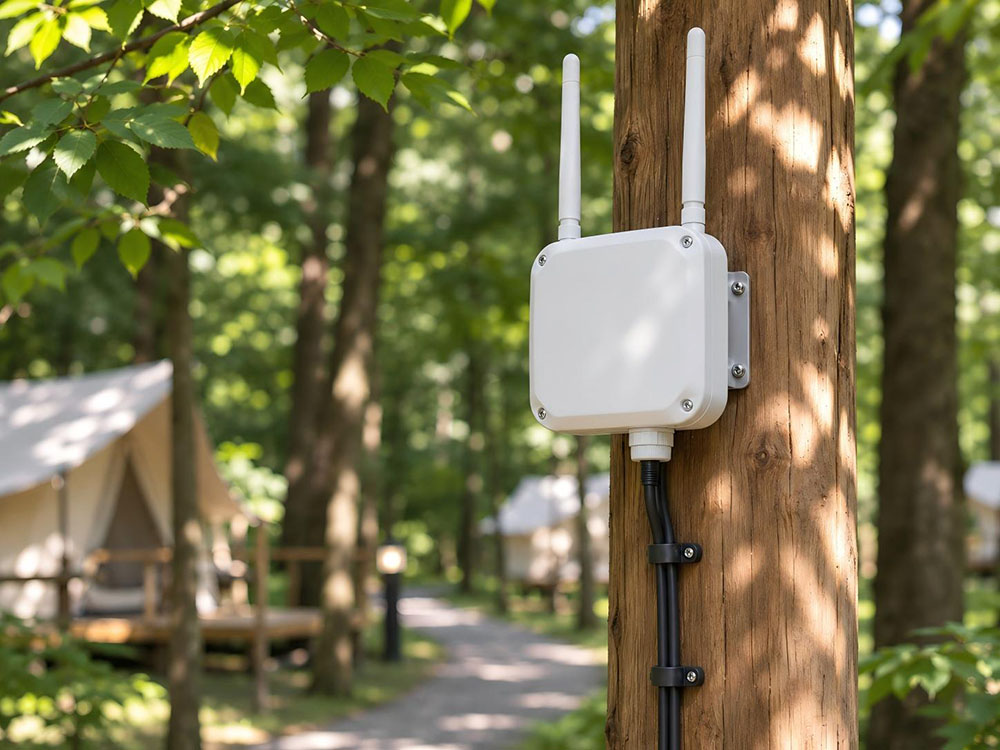
Add Outdoor WiFi Access Points
Outdoor WiFi access points can help address coverage gaps near campground entrances, parking areas, the ends of marina docks, or between individual sites. Compared with simply increasing transmission power, placing access points at suitable locations and adjusting their number and coverage direction can improve actual network performance. Before installation, conduct a site survey to record signal strength, sources of interference, user density, and actual throughput at different locations.
Use Wired Backhaul or Wireless Bridges
When pedestals, access points, or management areas need to exchange substantial amounts of data reliably, wired backhaul is worth considering. Fiber optic cables are suitable for longer distances and can reduce electrical interference between connected equipment. However, operators should account for installation work, optical conversion equipment, and future maintenance.
Use Cellular Communication or Backup Backhaul
When a campground is far from fixed broadband infrastructure or cabling costs are high in certain areas, a 4G or 5G router may serve as the primary backhaul or a backup connection. Before deployment, test signal strength, upload and download speeds, latency, and performance during busy periods for different mobile operators. Confirm that the data plan can support continuous device connections and data uploads.
| Solution | Suitable Applications | Main Benefits | Planning Considerations |
|---|---|---|---|
| Add outdoor WiFi access points | Campsites have coverage gaps, and guests need WiFi access on their phones | Improves wireless coverage for user devices and supports network segmentation by area | Requires a site survey, suitable backhaul, and outdoor protection |
| Wired backhaul or wireless bridges | Pedestals are spread across large areas, and certain locations need reliable connections | Wired connections provide stable data transmission, while wireless bridges can reduce some excavation work | Check cable distance, line of sight, interference, and installation costs |
| 4G or 5G backhaul and backup links | Remote areas have limited fixed broadband availability | Offers flexible deployment for selected areas or backup connectivity | Check carrier coverage, data costs, latency, and automatic failover |
Integrating Data Backhaul With QR Code Payments
Establish a Clear Data Backhaul Path
A typical data path may include smart pedestals, the site communication network, a gateway or edge controller, the management platform, and the payment service. The equipment and connection methods depend on the pedestal control architecture. Some devices connect directly to the management platform, while others send data through a shared gateway.
Depending on the device capabilities, pedestals can upload electricity readings, operating status, fault alerts, and communication status. The management platform associates device identifiers with campsites, users, billing rules, and historical records. Before deployment, define data upload intervals, retry mechanisms, data recovery procedures during communication outages, and synchronization after devices reconnect. These measures help prevent missing or duplicated records when the network experiences a temporary interruption.
Design the QR Code Payment and Pedestal Control Process
QR code payments can connect users, campsites, pedestals, metering records, and bills. In a typical process, a user scans the QR code on a pedestal and opens the associated service page. The user confirms the campsite or device information and completes the payment through the supported payment flow. After the payment service returns a transaction result, the business system verifies the transaction status, amount, and associated identifiers before updating the bill or authorizing the requested service.
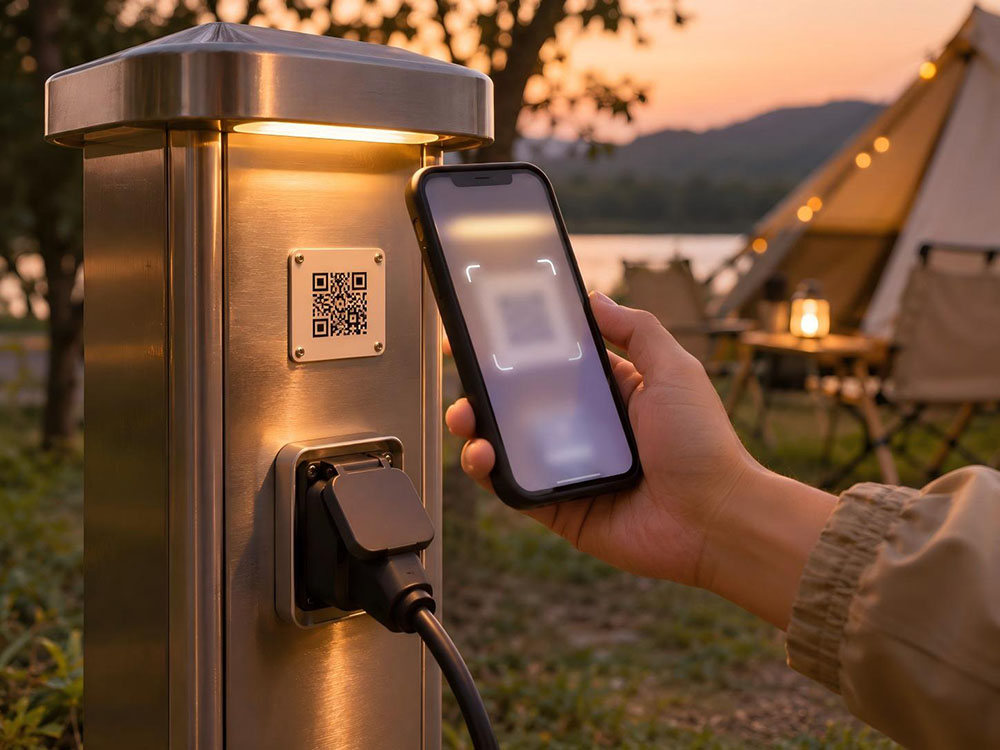
QR codes can identify a pedestal, campsite, or order entry point, depending on the service design. Static QR codes are suitable for identifying equipment or opening a service page. Dynamic QR codes can link a specific order and amount when the system supports this function. Regardless of the type, operators should protect against QR code replacement, repeated use, and incorrect device associations. Users should also be able to verify the service location and charges before paying.
Installation and Acceptance Checklist
Acceptance testing should cover more than WiFi availability. It should also verify backhaul performance, pedestal communication, data records, QR code payments, and recovery from outages. Testing each function before the campground opens can reveal coverage gaps, interface incompatibilities, and incorrect billing associations.
Check WiFi Coverage and Backhaul Stability
Based on the site layout, acceptance testing should cover entrances, offices, public areas, campsite boundaries, and the ends of marina docks. In addition to signal strength, test actual upload and download speeds, latency, packet loss, and connectivity under high demand. In areas that use wireless bridges, test the bridge connection and user device connectivity separately to avoid treating a healthy backhaul as proof of adequate WiFi coverage.
Testing should also include locations where signals may be weakened by large vehicles, metal structures, or other obstacles. Define acceptance criteria before construction and adjust them to the intended services and equipment. Pedestals that only report basic status may have different latency and availability requirements from terminals that handle real-time payment interactions. Signal strength alone should therefore not determine whether the entire installation passes inspection.
Verify Pedestal Communication and Data Accuracy
Check each pedestal identifier against the campsite identifier, backend equipment record, and physical label to confirm that the platform displays data for the correct device. Test online status, electricity readings, fault alerts, and control command feedback. Verify that devices can reconnect after a temporary outage and synchronize historical data according to the system design.
For pedestals that support remote switching, check authorization rules and execution status. Confirm that repeated clicks, communication delays, or duplicate commands do not cause unintended operations. Electrical testing must be carried out by qualified personnel in accordance with product instructions and applicable electrical codes. Electrical protection and safety interlocks must remain in place during network testing.
Verify QR Code Payments and Billing
Use an authorized test process to verify successful payments, failed payments, repeated submissions, cancelled orders, and delayed transaction results. Staff should confirm that the order identifier, pedestal identifier, amount, and payment status are correctly associated. They should also check that bill updates or service authorization after payment follow the defined business rules.
| Acceptance Item | Test Requirements | Records to Keep |
|---|---|---|
| WiFi coverage | Check signal strength and actual connectivity at main campsites, public areas, and site boundaries | Record test locations, signal measurements, and connection results |
| Backhaul connection | Verify connectivity and stability for fiber, Ethernet, wireless bridges, or cellular links | Record link types, device status, and observed faults |
| Outdoor installation | Inspect equipment mounting, cable protection, waterproofing, grounding, and service access | Record inspection results and corrective actions |
| Pedestal communication | Check device identifiers, online status, metering data, and fault reporting | Keep equipment lists and backend test records |
| Remote control | Test control commands, execution feedback, and fault handling where supported | Record command results and recovery behavior |
| QR code payments | Verify payment status, order associations, duplicate requests, and failed transactions | Keep test orders and payment reconciliation records |
| Outage recovery | Check reconnection, data recovery, order synchronization, and backup link switching | Record recovery times, data integrity, and fault logs |
| Security and handover | Check network segmentation, access permissions, configuration backups, and maintenance documents | Hand over configuration records, equipment lists, and maintenance instructions |
Organize Handover Documents and Maintenance Plans
After testing, archive the network topology, equipment list, cable labels, switch ports, pedestal locations, system configurations, and acceptance records. Site managers should also understand how to identify offline devices, review communication alerts, investigate payment issues, and contact the relevant suppliers. For equipment that depends on cloud platforms or external communication services, document account management procedures, support contacts, and system update arrangements.
During operation, monitor pedestal availability, communication outages, payment failure rates, and billing discrepancies. Use these records to adjust access point locations, backhaul capacity, or maintenance schedules. If the campground plans to add campsites, metering equipment, or automated functions, complete handover documents will also help technical staff assess whether the existing network can support expansion.
Conclusion
Campground WiFi and smart pedestal connectivity require coordinated planning for wireless coverage, data backhaul, device communication, and payment processing. Depending on site conditions, operators can improve weak signal areas by adding outdoor WiFi access points, using wired backhaul or wireless bridges, or introducing cellular connections. The final choice should be based on site testing and equipment compatibility.
Operators who are upgrading campground or marina power facilities should confirm pedestal interfaces, network architecture, billing procedures, and outage handling rules before construction. Complete end-to-end testing before opening the upgraded facilities to guests. Jiya Intelligent’s Power Stanchion product information and Power Pedestal FAQ also provide references for reviewing power pedestal products and related questions during equipment selection and project planning.

About the Author
Yunpeng Ren
Senior Electrical Engineer
Yunpeng Ren is a Senior Electrical Engineer with a degree in electronics and electrical engineering. He leads the e-Chongxing water and power management platform, applies new energy charging technology, and handles R&D and certification for RV campground and marina pedestals.