
Marinas sit on open water under a wide sky, built from steel, aluminum, and concrete. That mix draws lightning and spreads its energy through every conductor, railing, and boat the current can reach on the way to ground. Damage does not require a direct hit on a pedestal.
Marine lightning protection is the design work that gives that current a safe, predictable path while keeping people away from energized metal. It combines a lightning protection system, bonding, grounding, and surge protective devices, and it must coexist with the electrical codes that already govern a dock.
This guide covers the threats a dock faces and how the NFPA 780 framework applies to marine structures. It also explains why grounding on the water side deserves special care and how to keep the whole system serviceable across the seasons. JIYA supplies water and electric pedestals for marine and recreational sites, and this article addresses the engineers, contractors, and operators who specify them.
Key Takeaways
- Open exposure, metal structure, and water combine on a dock, so lightning energy can reach a pedestal through both direct and induced paths.
- NFPA 780 sets the installation framework for lightning protection systems, covering air terminals, conductors, and grounding electrodes.
- Bonding ties every metal part of the dock and its equipment together so they rise and fall in voltage as one assembly.
- Water carries current away from a strike point, which is why a potential gradient near a dock is a serious shock hazard.
- NEC 555.37 requires an insulated equipment grounding conductor sized per 250.122 and never smaller than 12 AWG at a marina.
- Surge protective devices manage the overvoltage that reaches wiring, and they support grounding rather than replace it.
- Every step belongs to the locally adopted code edition and to the authority having jurisdiction (AHJ).
How Lightning and Induced Surges Threaten a Dock
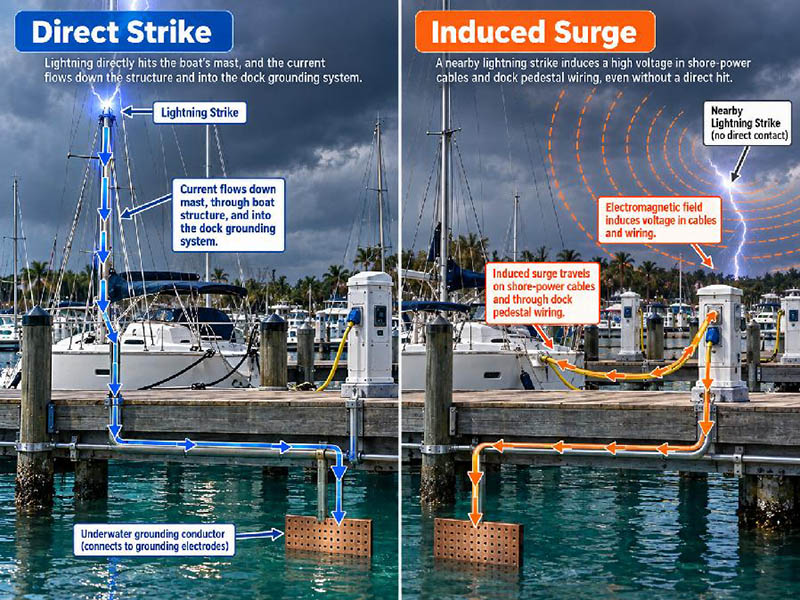
Lightning creates two problems on a dock, and they arrive in different ways. The first is the direct strike, where current enters the structure itself. The second is the induced surge, where a nearby discharge couples energy into conductors that were never touched. Both demand attention, because a dock rarely fails from the strike alone.
Direct Strikes and the Dock Structure
A direct strike on a boat mast, a light pole, or a dock building sends current down through the structure to ground. Along that route it passes through every bonded connection and into the buried and submerged metal below. Steel, aluminum, and concrete with embedded rebar give the strike many paths to choose from. Protection cannot stop the strike. Its only job is to control where the current flows once it arrives.
Induced Surges on Wiring and Boats
Nearby strikes still matter, because the changing electromagnetic field around them induces voltage in long runs of wiring. Feeder cables, pedestal circuits, and shore power cords all act like antennas for that energy. A surge can travel along a shore power cord into a boat panel, and it can also reach a pedestal from the grid side. Surge protection is therefore a wiring concern as much as a structural one, since the energy enters through connections rather than the sky above them.
The NFPA 780 System Applied to Marine Structures
The National Fire Protection Association (NFPA) 780, Standard for the Installation of Lightning Protection Systems, is the installation framework most North American projects follow. It describes the parts of a system and how they connect, and it applies to marine structures with the adjustments a wet, corrosive site demands.
Air Terminals and Down Conductors
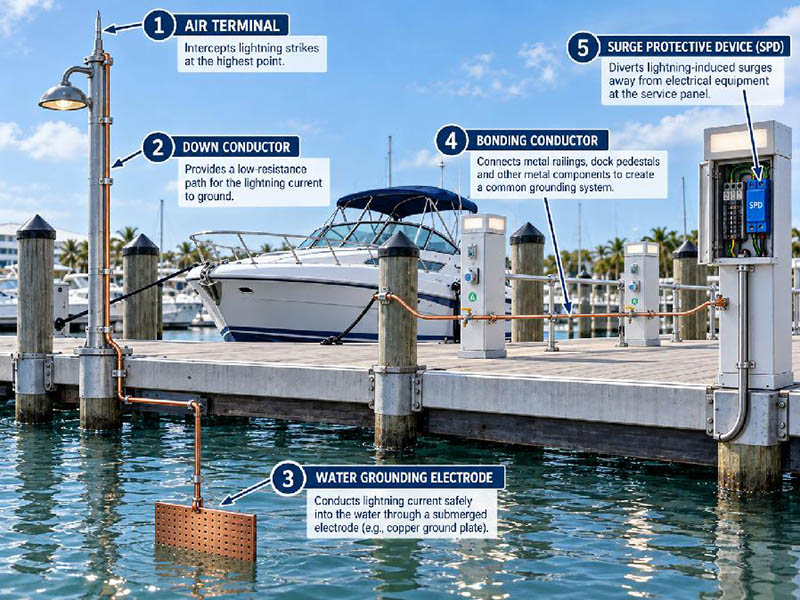
Air terminals, also called strike termination devices, are the metal points at a structure’s high points that intercept a strike. Down conductors then carry that current to the grounding system. On a dock, those conductors must avoid sharp bends and loose connections, because a strike follows the path the designer provides. Materials and fittings matter here, since salt air and spray corrode ordinary hardware quickly.
Grounding Electrodes and Materials
The grounding electrode system gives lightning current a place to enter the earth. On land it may be rods, plates, or a concrete-encased electrode. At a marine site the water itself becomes part of the path, and the design must account for that route. Because every buried and submerged component has to survive years of salt and moisture, corrosion is the constant concern. Components must match the material rules in the standard and be installed so they stay conductive.
| Component | Function | Marine consideration |
| Air terminal | Intercepts a strike at the high points | Use corrosion-resistant material and secure mounting |
| Down conductor | Carries strike current to the grounding system | Keep runs direct and avoid sharp bends and loose joints |
| Grounding electrode | Routes current into earth or water | Choose materials rated for submerged and salt exposure |
| Bonding conductor | Keeps metal parts at one voltage | Bond across joints that paint or gaskets can interrupt |
| Surge protective device | Limits overvoltage on wiring | Coordinate with grounding, never treat it as a substitute |
Bonding Metal Structures and Berth Equipment
Bonding is the practice of connecting metal parts so they share one voltage, and on a dock that duty covers a long list. Main structures, gangways, railings, light poles, service pedestals, and the frames and fittings of visiting boats all belong to the same conductive assembly. When a strike hits one part, a bonded structure rises and falls in voltage together instead of arcing between sections.
Equipotential Bonding of Docks and Pedestals
Equipotential bonding removes the voltage difference that drives a shock or a spark. Every metal enclosure should tie back to the grounding system, and the pedestal is a key junction because it is where shore power, boat connections, and people all meet. Hinged doors, device yokes, and mounting posts each need their own bond, since a hinge or a painted joint does not guarantee a path. JIYA builds water and electric pedestals with clear bonding points so field crews can make these connections without guesswork.
Water-Side Grounding and the Risk of Potential Gradients
Water changes the rules of grounding in a way that dry land never does. Fresh water and salt water conduct differently, and the surrounding water often touches people who are swimming, wading, or standing on a wet ramp. Current that enters the water spreads outward from the point of entry, and that spread is the part many designs underestimate.
Voltage drops with distance as the current spreads, and the difference between any two points is a potential gradient. Standing in that gradient, a person can become a parallel path for current, and the effect is worst in fresh water because the human body conducts better than the surrounding water. This is why a sound design limits stray current and keeps people away from the water near a strike. Grounding and bonding on the water side reduce the voltage differences that would otherwise reach a person.
Coordinating Lightning Protection with Berth Grounding Rules
A lightning protection system does not replace the electrical grounding that Article 555 already requires for a dock. The two systems share the same metal, so they must be coordinated rather than built as rivals. NEC 555.37 requires the equipment grounding conductor at a marina to be an insulated conductor, sized per 250.122 and never smaller than 12 AWG.
That insulated conductor serves the fault path, while the lightning system serves the surge path, and both benefit from the lowest practical impedance. The goals reinforce each other, because a solid equipotential plane helps fault current clear just as it helps surge current spread. Berth feeders and boat supply receptacles also carry ground fault protection under the 555.3, 555.35, and 555.36 rules, which we explain in our note on NEC 555.35 and 555.36. Grounding, bonding, and ground fault protection form one safety layer rather than three separate fixes.
Surge Protective Devices and Their Role on a Dock
Lightning protection controls the strike, but overvoltage still reaches the wiring, and that is where surge protective devices (SPDs) work. An SPD limits the transient voltage that appears on a circuit and diverts that energy toward ground. It belongs at the service and at points closer to the equipment it protects, with a short and direct connection to the grounding system. The routing and the conductors fall under the SPD provisions of the National Electrical Code (NEC).
Surge devices support the grounding system and never substitute for it, because a device can only divert what its bond to ground can carry. That is why an SPD on a dock with poor bonding offers little real protection, and why the bond is the first item to verify. Our companion article on ground fault protection in marinas covers the related protection layer that guards people.
A Lightning-Season Inspection Checklist
Because marine hardware ages quickly, an inspection before storm season and again after storms pass catches the defects that quietly undermine the design. Steps 1 through 8 cover the sequence a maintenance crew can follow.
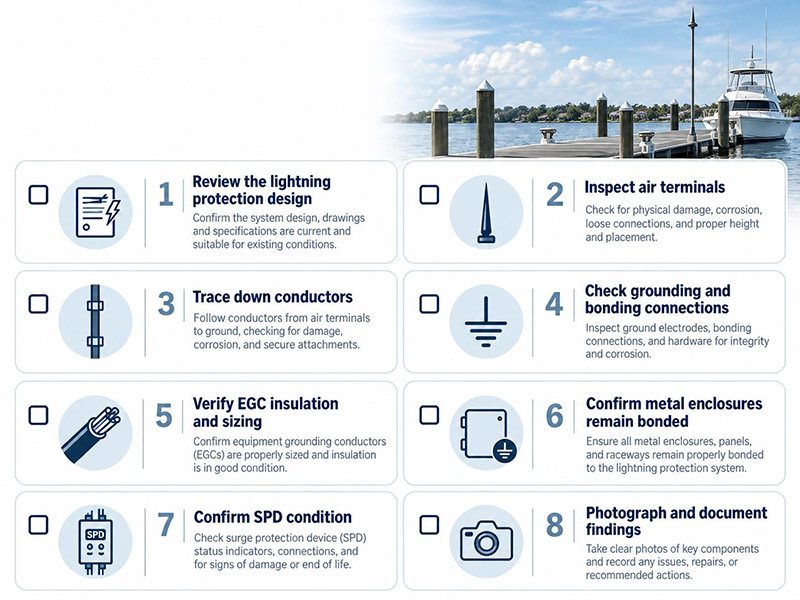
- Review the lightning protection design and confirm it still matches the dock as built.
- Inspect every air terminal and its mounting for corrosion, looseness, or physical damage.
- Trace each down conductor and look for sharp bends, missing fasteners, and broken joints.
- Check grounding and bonding connections at the service, the structure, and every pedestal.
- Confirm the equipment grounding conductor is insulated and meets the 555.37 sizing rule.
- Verify that every metal enclosure, door, gangway, and railing remains bonded.
- Confirm that surge protective devices are intact and that their ground connections are tight.
- Record findings with photos and dates so the next inspection has a baseline to compare against.
Defects the Walkthrough Should Catch
Most failures trace back to a handful of recurring errors, and each one breaks a path the design assumes is complete. The table below pairs each mistake with the risk it creates and the fix that resolves it.
| Common mistake | Why it matters | Correction |
| Treating a lightning system as optional on a dock | A strike finds whatever path it can, including people and boats | Install a lightning protection system per NFPA 780 and bond it to the dock |
| Relying on a single ground rod | The earth is a poor conductor over short distances | Build a grounding electrode system and keep every bond continuous |
| Skipping a bond across a hinge or joint | Paint, gaskets, and corrosion interrupt the path over time | Add a bonding jumper across each movable or coated joint |
| Using bare or undersized grounding conductors | Corrosion and overload can break the fault path | Use an insulated EGC sized per 250.122, never smaller than 12 AWG |
| Assuming an SPD replaces grounding | The device can only divert what its ground bond can carry | Coordinate the SPD with the grounding and bonding system |
| Inspecting only after a problem appears | Damage from the last storm stays hidden until the next one | Inspect before and after storm season and document each pass |
Bonded and grounded as one assembly, a dock gives a strike current a defined route and keeps people out of its way.
FAQ
How is a dock grounded for lightning?
A dock uses a lightning protection system with air terminals, down conductors, and a grounding electrode system, and every metal part is bonded to that system. The design follows NFPA 780 and must also satisfy the electrical grounding rules in Article 555. Confirm the details with your AHJ.
Can a boat be struck by lightning while connected to shore power?
Yes. A strike on the boat, on the dock, or in nearby water can send current through the shore power cord and the dock wiring. Bonding and surge protective devices limit the damage, and the boat’s own protection under the American Boat and Yacht Council (ABYC) standards works with the shore system.
Why is grounding on the water side different?
Water carries current away from a strike point and creates a voltage difference across the surface. That potential gradient can make a person part of the circuit, and the risk is greater in fresh water. Sound grounding and bonding reduce those differences near the dock.
Does surge protection replace grounding?
No. The device limits transient voltage and diverts energy, but it depends on a solid connection to the grounding system. Grounding, bonding, and surge protection work as one coordinated system, and no device alone can carry the energy a strike delivers.
What should be checked before storm season?
Inspect air terminals, down conductors, grounding and bonding connections, and surge devices, and confirm the equipment grounding conductor still meets the insulated and minimum size rules in 555.37. Document each finding, because a small defect today becomes a large one after a strike.
Lightning protection on a dock rewards planning and steady maintenance, because the parts that matter most are the ones no one sees after the covers go back on. If your project needs pedestals with clear grounding and bonding provisions, reach out through our contact page and we will work through the details with your electrical engineer and your AHJ.

About the Author
Boda Pan
Engineer, JIYA Intelligent
Boda Pan is an engineer at JIYA Intelligent with five years of experience in outdoor power distribution. He specializes in RV power pedestals, water and power pedestals and marina water and electric pedestals, with a focus on IEC standards compliance.